North Middletown, Kentucky • Est. 1948 • Home of the Kings

Save North Middletown Elementary School.

The district's best elementary school is the one on the chopping block. On July 15, 2026, a planning committee voted to reclassify North Middletown Elementary as transitional, the first step toward closing it. I went through the district's own audits, state data, and two decades of public records. Here is what the numbers say. Every one of them is checkable, and I want you to check them.

58.2 vs 26.5NMES score vs the school set to receive its students (2024-25)
~24% at bestshare of the $2.65M deficit that closure would solve, on generous assumptions
610 peoplethe town that loses its heartbeat if the school closes

Written by Dr. Ryan Bradley, a former NMES King, with the help of an AI research assistant. Built from public records only. Full report and financial model at the bottom of this page.

Part One

The money problem is real. Closing NMES does not solve it.

The district ran a General Fund deficit of $2.65 million last year before transfers, and reserves are falling by about $1.1 million a year. I do not dispute any of that. The question is whether closing a 128-student school fixes it. It does not come close.

The General Fund, from the district's own audits

Check my work: FY2025 audit · FY2024 audit

What actually drove the deficit

Federal pandemic aid wound down, taking about $2.95 million a year with it, and attendance-based state funding fell as roughly 248 students left the rolls. Meanwhile, costs the district controls grew fast: central-office administration rose 44.8 percent in two years.

A fair caution I print beside this number: Kentucky audits fold state pension allocations into these expense lines, so some share may be accounting rather than hiring. That is why the report asks for a position-by-position accounting instead of assuming the worst.

Statement of Activities, both audits

The tax picture the budget talk leaves out

Bourbon County Schools taxes real estate at 52.4 cents per $100, second lowest of nine area districts and roughly 13 cents below the statewide school average. The board also holds a no-recall option to raise revenue 4 percent a year. The math is simple and it does not bend: either spending comes down or revenue goes up. Standing idle is the one answer I rule out.

KY Dept. of Revenue 2025 rate book · Fayette and Clark from board-vote reporting
Part Two

The school they want to close is the one that works.

Toggle the schools below. North Middletown outscores every elementary in the county, in either district, and every one in neighboring Clark County. The schools designated to receive its students sit in the bottom quarter of the state.

Two decades of scores, every district elementary

SchoolDigger's normalized 0-100 score computed from state test data, a consistent cross-year yardstick, not KDE's official rating. No statewide tests in 2020; NMES 2021 not reported.

SchoolDigger, NMES year table

Room to grow: enrollment since 1989

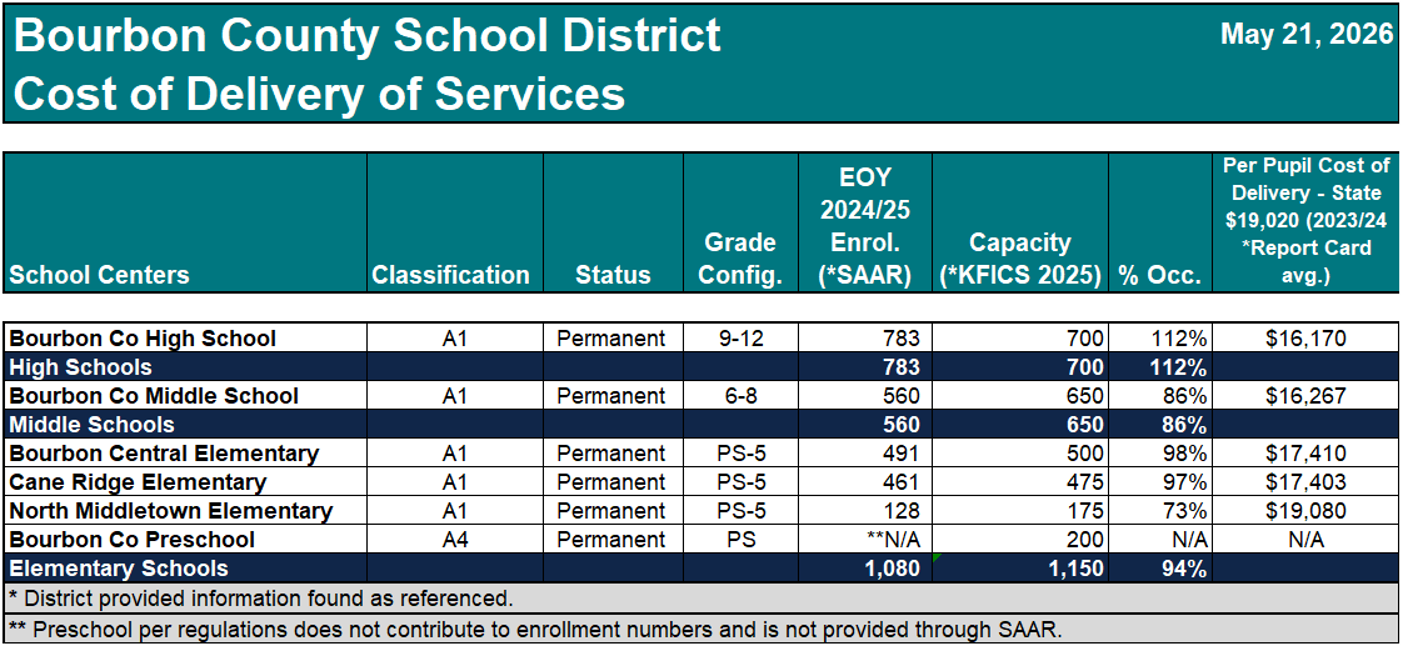
The building held 261 children at its peak. It holds 128 today against a rated capacity of 174. The seats exist; the plan to fill them, through redistricting and cross-county enrollment on quality, is in the full report.

Federal enrollment history · 2021 state facility plan (capacity 174)
"There is always a solution to a problem if you persist through it." What Mrs. Mitchell's classroom taught me, 24 years ago, in this building. A 2011 National Blue Ribbon School, and climbing back toward that standard today under its current staff.
Part Three • Interactive

Do not take my word for it. Run the numbers yourself.

These are the same models from the report's companion workbook. Move the sliders. Use the district's assumptions or your own. The conclusion is hard to escape either way.

The closure calculator

What does closing NMES actually save, once teachers follow students, buses roll farther, and some families leave the district and take state funding with them?

$361,240
estimated net recurring saving per year
That covers 13.6% of the $2.65M structural deficit.

The 4 percent option

State law lets the board raise property-tax revenue 4 percent a year from existing property, no recall exposure. It compounds. Slide the years.

$1,203,816
added recurring revenue per year, by that point
That covers 45.5% of the structural deficit. Bourbon would still tax below six of its eight neighbors.

Basis: KRS 160.470, applied to fiscal 2025 collections of $9,641,017. The levy is one option, not the only one. But revenue or reductions, the board must choose one and own it.

Every formula here matches the downloadable workbook, tab by tab.
Part Four

A menu worth more than closure.

Conservative, sourced, and adjustable in the workbook. Even the low end beats the most generous closure estimate, and none of it takes a school from a town.

MeasureEstimated annual value
Take the 4 percent revenue option (year one; compounds thereafter)$386,000
Trim central-office growth back toward its FY2023 level$200,000 to $450,000
Transportation efficiency review (routing, fleet, fuel)$145,000 to $290,000
Medicaid billing, energy performance, and shared services$170,000 to $400,000
Grow NMES enrollment across county lines (state funding follows the student)$150,000 to $300,000
Recover part of ordinary tax delinquencies$60,000 to $120,000
Conservative combined range: $1.1 to $2.1 million a year • Closure, at best: about $640,000

Figures are estimates with stated assumptions; the exact basis for each sits in the report and the workbook. Ranges overlap and are haircut in the combined total.

Part Five

Ten questions the board should answer in writing before any vote.

These are not rhetorical. Each has a document behind it that the administration either already holds or should be required to produce. Tap to read.

What is inside the "over a million dollars" figure?

How does it reconcile with the state's published per-student spending, and which enrollment count is being used? Federal data show 128 students, while public statements have ranged lower.

What is the projected net saving, published as a worksheet?

Costs that truly disappear, minus added transportation, transition costs, and revenue lost with departing students, signed by the finance officer.

What happens to the per-student cost argument when SEEK follows the student?

State funding travels with children. Show the revenue side of the ledger, not just the cost side.

Where will the students go, and what are those schools' capacities and scores?

The designated receiving schools scored 26.5 and 19.3 last year. Publish capacity, class sizes, and the transition plan.

How long will the youngest children ride the bus?

Publish modeled route times for the students of North Middletown, by age, before any vote.

Why did central-office administration grow 44.8 percent in two years?

Position by position, dollar by dollar, including how much is state pension allocation versus local decisions.

What is the stated purpose of the 2024 $6.055 million bond issue?

Publish the official statement and the BG-1, and state when NMES last received meaningful capital investment.

What would it cost to keep the empty building?

Closed schools still need insurance, heat, and maintenance. Publish the carrying cost and the disposition plan.

What alternatives were modeled before "transitional" reached a vote?

If a menu like the one above was never priced, the community deserves to know that too.

What does the district project for enrollment, using the levers it controls?

Redistricting and cross-county enrollment are board decisions, not demographic fate. Show the projection with and without them.

Part Six

What you can do this week.

Show up Thursday

July 23 • 6:30 p.m. • at the school

Community meeting at North Middletown Elementary. Children are invited to write a love letter to the school. Bring your neighbors.

Show up to the forum

July 29 • Local Planning Committee

The committee that voted "transitional" meets again on the draft facility plan. Its vote is advisory; the audience is not.

Sign and share

Two minutes

Add your name to the petition asking the board to pause any vote until the ten questions are answered in writing.

Sign the petition

Write the board

Five minutes

Superintendent Larry Begley and board members Bradley Purcell (chairman), Jonathan Ott (vice chairman), Mandy Thornberry, Miranda Wyles, and Shane Buckler. The button below starts an email to the superintendent and all five board members; addresses are also on the district board page. Ask for one thing: answers in writing before any vote.

Start an email  Call the central office

Read the full case

The 22-page report and the complete financial model behind every number on this page.

Download the report (PDF)  Download the model (Excel)
Check My Work

Sources

Every figure on this page traces to one of these. If you find an error, tell me and I will correct it publicly.